
TL;DR
In 2023 I audited a classic car marketplace with 671 referring domains against a market leader with 29,812, and told the client to spend more on links. The number that mattered was in my own table and I walked past it: a competitor with 845 referring domains was doing nearly four times the client’s traffic on 8% of the pages. Links were not the gap. Ninety percent of the client’s site was unreachable.
The client had 671 referring domains. The biggest competitor in the market had 29,812. That comparison is in the audit, and so is my conclusion, which was to shift the budget towards link building.
I would write the opposite now, and the evidence for it was already on the page.
The four rows
Here is what the competitor table actually held, as of that audit.
The comparison, in full
- The client. 9,220 pages indexed, 671 referring domains, 7,998 monthly organic visits.
- Market leader one. 334,000 pages, 29,812 referring domains, 497,000 visits.
- Market leader two. 131,000 pages, 38,200 referring domains, 1,894,000 visits.
- The fourth site. 779 pages, 845 referring domains, 30,613 visits.
Read the fourth row again. 845 referring domains is 26% more than the client had. 779 pages is 8% of what the client had indexed. And it was doing 30,613 monthly visits against the client’s 7,998, which is nearly four times the traffic.
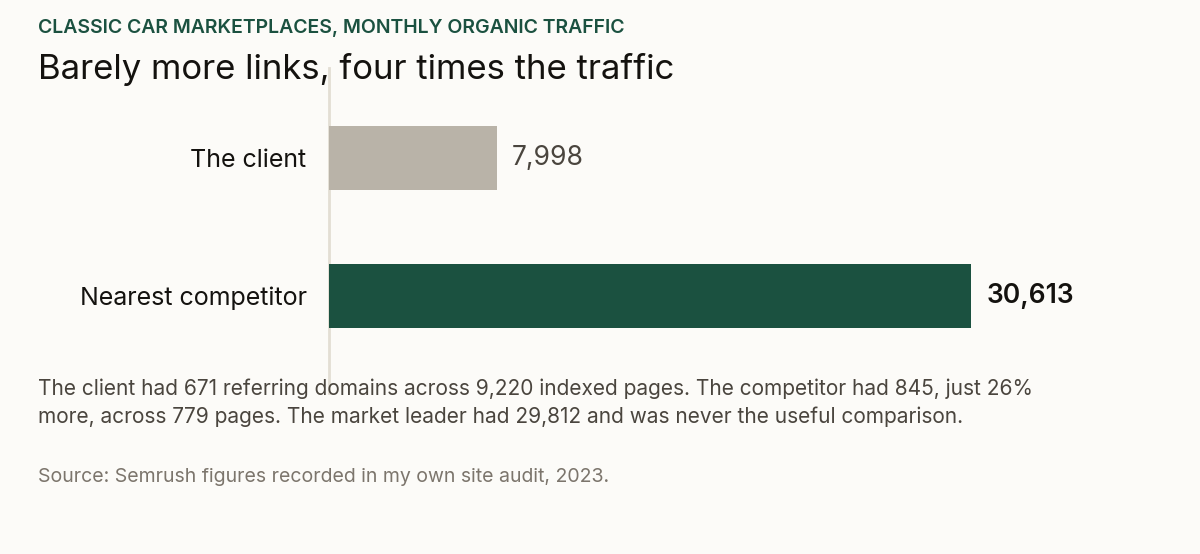
So the answer to “how many links do I need to rank” for that site, taken literally, was about 174 more than it already had. And getting them would not have worked, because links were plainly not what separated those two sites.
What actually separated them
The same audit found 8,317 orphan pages out of 9,220 indexed. Ninety percent of the site could not be reached by a crawler following links from any other page on the site. The pages existed, Google knew about them, and nothing pointed at them.
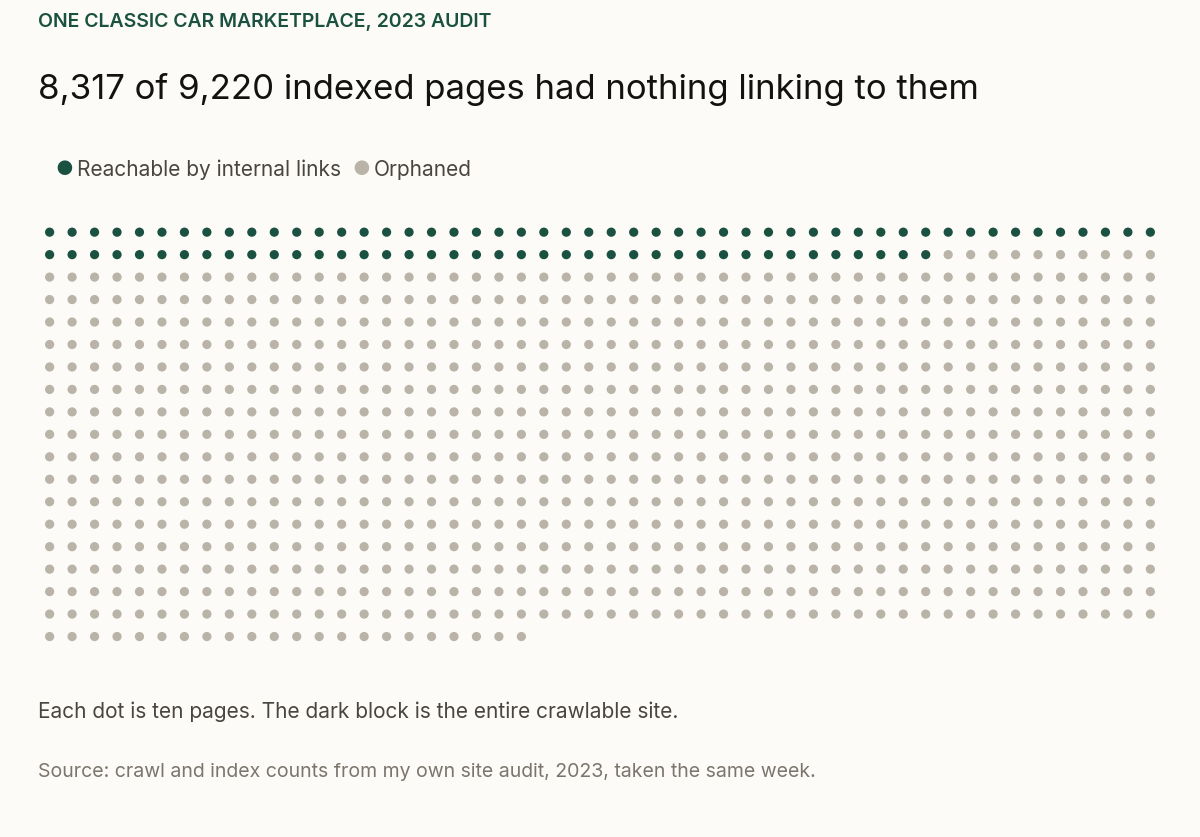
That site did not have a link shortage. It had a link distribution failure, entirely inside its own walls, and it was pouring whatever authority it had into a structure that could not carry it anywhere. Meanwhile a competitor with 779 tightly connected pages was moving the same amount of authority around a site small enough for all of it to land.
I have written elsewhere about why more pages and more links are not the same lever. This audit is the clearest case I have of the two being confused, and I am the one who confused them.
Why the mistake is easy
Competitor tables invite you to read down the biggest column. 671 against 29,812 is a forty-fold gap and it looks like an explanation. It fills the space where a diagnosis should be, and it is very easy to write, because the client already believes it. Everybody arrives believing they need more links.
The useful competitor is almost never the biggest one. It is the one closest to you on the metric you are about to spend money on, that is beating you anyway. If a site with roughly your link profile is out-performing you four to one, links are not your constraint, and buying more of them is buying the wrong thing at full price.
So what is the number
There is not one, and the reason is in how Google describes links rather than in any count. Google says it uses links as a signal when determining the relevancy of pages and to find new pages to crawl. Relevancy and discovery. Neither of those is a scoreboard, and neither has a threshold you cross.
The spam policies point the same way. What Google names as link spam is defined by intent, not volume, right down to creating low-value content primarily for the purposes of manipulating linking and ranking signals. A policy written around counts would say so. This one is written around why the link exists.
What I would tell that client now
Fix the internal structure first, because 8,317 unreachable pages is a problem you can solve without asking anyone’s permission. Then look at whether the pages that remain deserve to rank. Then, and only then, ask whether links are the constraint, and answer it by finding the nearest competitor who is beating you rather than the largest.
Two related pieces. Relevance or authority is the question underneath this one, because 845 relevant links and 845 general ones are not the same asset. And auditing a backlink profile is worth doing after you know links are the problem, not as the opening move.
The short version
- 671 against 29,812 looked like the story. It was not, and I wrote it up as if it were.
- The number that mattered was 845. A competitor with 26% more links and 8% of the pages did four times the traffic.
- Ninety percent of the client’s site was orphaned. 8,317 pages out of 9,220 indexed.
- Compare against the nearest competitor beating you, never the largest one in the market.
- Google describes links as relevance and discovery, not a count you cross.
- If a site with your link profile beats you four to one, links are not the constraint.
If a site should be ranking and it isn’t, that’s the work I do. Link building covers the off-site half, including when not to bother, and internal linking is usually the cheaper answer to the same question.