
You already know what a case is worth. That’s why the clicks cost what they do.
Competitive personal injury terms run $150 to $300 a click in most markets, over $500 in Los Angeles, New York and Miami, and past $1,000 for some specialised injury types. They are the most expensive clicks in legal, and among the most expensive anywhere.
Which is the whole argument for search. Recent industry figures put the average SEO lead for a personal injury firm at $183 against $442 from Google Ads. You are not choosing between marketing and no marketing. You are choosing between paying for every click forever and building something that keeps working.
That’s the pitch every agency makes. Here is what I’d rather show you.
A law firm’s Google Business Profile, twelve months
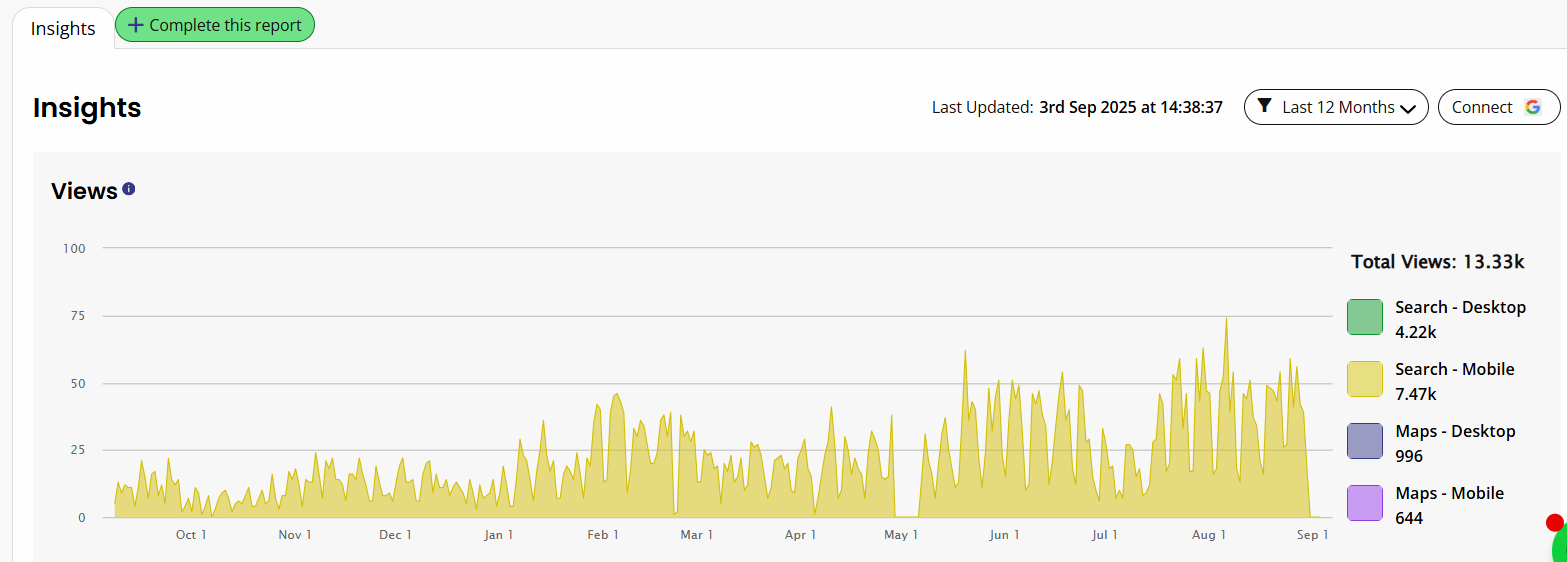
13,330 profile views over the year. 7,470 from mobile search, 4,220 from desktop, the rest from Maps.
The shape matters more than the total. October through January sits flat at ten to twenty views a day. From February it steps up and holds, running at forty to seventy-five a day through the summer.
The work went live two to three weeks before that step.
What was actually done
I’ll be precise about this, because “we did SEO and it went up” is not information.
I came into this as a consultant. The firm was the client of an agency I work with on a white-label basis. I set the strategy and handled link building, and the agency’s team implemented alongside me. So this is a shared result, not a solo one.
What went in:
- Practice area pages, proper ones, for each type of case the firm actually takes
- Service area pages, for the places the firm genuinely serves, not every town within fifty miles
- Real content on the service pages, replacing the thin versions
- Google Business Profile optimisation: categories, services, the full profile rather than the half of it most firms fill in
- Profile posts four times a week, consistently, and the consistency is the part almost nobody sustains
- Blog posts on the questions clients actually ask
- Titles, H1s, H2s and H3s rebuilt around what people search rather than what the firm calls things internally
- Internal linking, so the practice area and service area pages properly connected to each other and to the pages that convert
- Link building
What I can and can’t tell you from this
Everything above went live at roughly the same time. So I cannot tell you which piece moved the number, and neither can anyone who shows you a chart like this. If someone tells you it was the profile posts, ask how they isolated that. Google has never confirmed those affect ranking at all.
What I can say is that the sequence is real: the work went in, and two to three weeks later the line changed direction and stayed changed for seven months. That’s a stronger claim than most case studies make and a weaker one than most agencies would make from the same data.
I should also be clear that these are profile views, not signed cases. Views are the top of the funnel. What happens between a profile view and a retainer depends on your intake, your reviews and your reputation, and no SEO work touches that.
What’s different about personal injury
Three things, and they change the plan.
The map pack is most of the game
Firms in the top three map positions take a disproportionate share of clicks, and page-two organic generates almost no intake. Your primary category is the single biggest Maps ranking factor in this vertical. Get that wrong and everything downstream is wasted.
Review frequency beats review score
Higher review counts correlate with higher local positions. Higher star ratings, on their own, don’t show a measurable effect. A firm with 60 reviews and a new one every fortnight outranks a firm with 200 from three years ago. Most firms are running the wrong metric.
Service area pages are legitimate here, and usually done illegitimately. A firm that genuinely handles cases across a metro should have a real page for each area: different courts, different accident patterns, different content. What most firms have instead is one page duplicated with the town name swapped, which Google names specifically as doorway abuse. That build fails as a set, dragging down the pages that would otherwise be fine.
The three things I’d check on your site first
-
Is your primary category right?
It’s the biggest single Maps factor in this vertical and it takes thirty seconds to look at. I’ve seen firms lose years to a category that describes the practice loosely rather than exactly.
-
Are your service area pages real?
Open two of them side by side. If the only difference is a place name, they’re hurting you collectively even where they’d rank individually.
-
Is anything pointing at your practice area pages?
On most firm sites they’re reachable from the menu and nowhere else. A menu link tells Google very little, because every page has it.
From an agency that works with law firms
Jessica Holland Owner and CMO, Holland Health Marketing, Denver CO
“I’ve seen only upward growth in every single one. We typically work with local-based services like law firms and healthcare.”
When you shouldn’t hire me
Worth saying, because everyone in this market promises the top three.
-
If you have very few reviews and no process for getting more,
fix that first. It costs nothing and it will do more for your map pack position than anything I can do to your website.
-
If your intake doesn’t answer the phone,
more visibility just means more missed calls. I’ve seen firms spend a year on rankings while losing leads at the front door.
-
If you need cases this quarter,
search isn’t the answer. The chart above took three weeks to turn and seven months to prove. Ads are the right tool for a deadline, expensive as they are.
-
If you’re in a top-five metro with no budget for links,
be realistic about the ceiling. The firms above you are spending five figures a month and have been for years.
I’d rather tell you that on a call than take a retainer and explain it in month six.
How I work
Most of what I do is diagnosis. Firms come to me with a site that should be ranking and isn’t, and the job is working out which of six plausible causes is the real one before anybody spends money on a fix.
I work directly with firms, and I work white-label through agencies, and the case above was the second kind. If you’re an agency with a personal injury client and no in-house technical depth, that arrangement works well and your client never needs to know I exist.
If a site should be ranking and it isn’t, that’s the work I do. Local SEO covers the profile and map pack side. If you’re not sure which of several plausible problems is costing you, that’s what an SEO audit is for, and if I look and there’s nothing worth fixing, I’ll tell you that.