

The verdict
Three firms in one city’s local pack, all rated 4.9, on 180, 113 and 111 reviews. The firm doing the serious work had nine. In criminal defence, review volume tracks charge severity inversely, so a plan built on winning the review race will fail at exactly the end of the docket that pays.
Every local SEO article says the same thing about reviews. Get more of them. Get them regularly. After your primary category, review count is the strongest thing you can influence for map pack position.
That advice is broadly right. For criminal defense it is close to useless, and following it will cost a firm two years.
What the local pack actually looked like
I pulled the local pack for “criminal defense attorney” in a mid-sized US city. Three firms, and they were not close.
| Firm | Practice focus | Rating | Reviews |
|---|---|---|---|
| Firm A | General criminal | 4.9 | 180 |
| Firm B | General criminal | 4.9 | 113 |
| Firm C | DWI | 4.9 | 111 |
Every one of them at 4.9. Every one over a hundred reviews. Two general criminal practices and a DWI specialist.
On the face of it that confirms the advice. Reviews win. Go and get reviews.
Except that in the same market there are firms handling far more serious cases, with far better outcomes, sitting on single-digit review counts and nothing posted in years, and they are not short of work.
Both of those things are true at once, and the reason why is the whole point of this post.
Review volume tracks charge severity, inversely
Think about who leaves a review.
Somebody who beat a DWI will leave one. It was frightening and expensive, it is over, and being publicly associated with it is embarrassing rather than ruinous. They are relieved and they say so, under their own name, with their photo next to it.
Now think about the other end of the docket. Somebody whose federal fraud charge was dismissed. Somebody whose child pornography allegation went away. Somebody acquitted of a violent offence.
They will not write a public review. Neither will their spouse, their parents, or anyone else who knows. The better the outcome you delivered, the more the client needs no permanent record that they were ever your client at all.
That is not a marketing problem you can solve with a better follow-up email. It is the service working correctly.
The consumer research says the opposite of what I am about to argue, and it should go on the table rather than be left out. BrightLocal’s 2026 Local Consumer Review Survey, covering 1,002 US adults and published February 2026, found 97% read reviews for local businesses, and that 31% will now only use a business rated 4.5 or above, nearly double the 17% who said so a year earlier. On the face of it, the firm with nine reviews is finished.
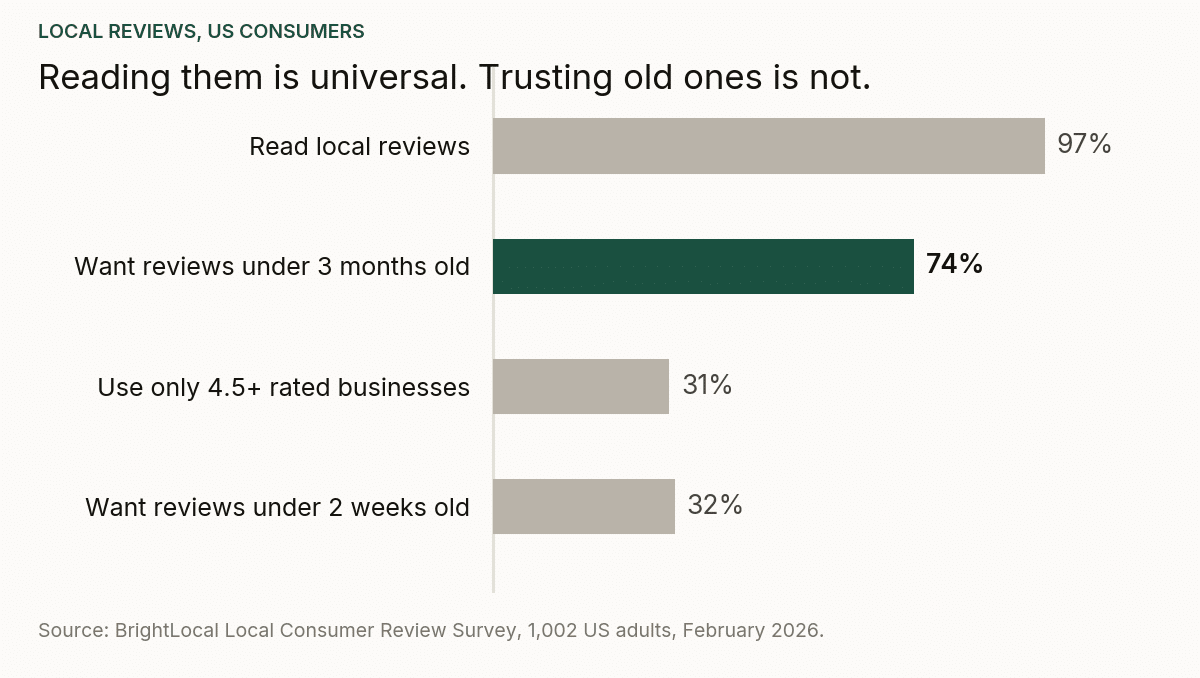
But look at what those people were asked about. Restaurants, plumbers, dentists, hairdressers. Nobody runs a survey on how people choose a criminal defence lawyer for a serious charge, because the sample is small, the moment is private, and people do not volunteer it afterwards. So the best available data does not describe this market, and the three firms with a hundred reviews each, sitting above the firm doing the work I would want done, is the closest thing to evidence I have that it does not transfer.
Look back at the table. Two general criminal practices and a DWI specialist. Those are exactly the practices whose clients can afford to be seen.
Why this matters more than it sounds
Every study telling you review count is the second-strongest local ranking factor is averaging across restaurants, dentists, plumbers and driving instructors: businesses where the customer is glad to be seen. The average is real. Your practice is the exception to it.
The failure mode I see is a serious felony practice deciding that reviews are the gap, building a review generation process, running it diligently for eighteen months, and arriving at fourteen reviews. Not because the process was bad. Because the thing they were asking for was the thing their clients most needed not to exist.
Eighteen months, and the map pack position has not moved, and the conclusion drawn is usually “SEO doesn’t work for us.”
What replaces it
If you cannot win on consumer reviews, you win on professional credential instead. In a category where consumer proof is structurally scarce, that is what does the trust work, both for the person deciding at two in the morning, and for the systems reading your page.
This is not a pick-one list. They stack, and in my experience the more of them you carry the better. Each is an independent party vouching for you, and a reader who does not recognise one will recognise another.
Martindale-Hubbell AV Preeminent. Peer-reviewed rather than client-reviewed, which is precisely the point. It is the one rating in legal that a client cannot supply and cannot fake.
Avvo rating and a complete Avvo profile. Consumer-facing, but built from case history and credentials rather than testimonials.
State bar listing and any board certification. Criminal law board certification exists in several states and almost nobody displays it prominently.
Google Screened, where it is available for your practice area.
The part firms get wrong is placement. These end up as small grey logos in a footer, or on an About page nobody visits. They belong on the home page and on the practice area page for the charge in question, at a size that reads as a claim rather than a decoration.
The reviews you can get, you should still get
None of this means abandon reviews.
A defence practice usually has a mix. The DWI and possession end of the docket produces clients who will happily review you. The felony end does not. The mistake is to set one target across the whole practice and judge yourself against it.
Ask the clients who can. Do not build a strategy that depends on the clients who cannot.
And when you are looking at a competitor with 180 reviews and wondering how they did it, check what they actually do before you conclude you are behind. Very often they are not beating you. They are running a different business.
What I would look at instead
If your firm sits at the serious end and the map pack is not working, review count is unlikely to be the lever. Three things usually are.
- Your primary category. It is the single largest Maps ranking factor and it takes thirty seconds to check. “Criminal justice attorney”, “Law firm” and “Criminal defense attorney” are not interchangeable.
- Whether you have a page for the actual charge. Somebody facing a specific allegation is not searching “criminal defense attorney”. They are searching the thing that has happened to them, at two in the morning, on a phone. A page that names it is a completely different experience from a page that lists it in a bullet, and those queries have a fraction of the competition of the head term.
- Whether anything links to your practice area pages. On most firm sites they are reachable from the menu and nowhere else, and a menu link tells Google very little because every page has one.
The short version
- The local pack in one mid-sized city: three firms, all rated 4.9, on 180, 113 and 111 reviews. Two general criminal, one DWI.
- Review volume in criminal defense tracks charge severity inversely. The better the outcome at the serious end, the less the client wants a record of you.
- A strategy that depends on winning the review race will fail at that end of the docket, and it will take you eighteen months to find out.
- Professional credential replaces consumer review. Put it on the home page, not in the footer.
- Get the reviews you can get. Do not build the plan around the ones you cannot.
If a site should be ranking and it isn’t, that’s the work I do. SEO for criminal defense attorneys goes into how this changes the rest of the build, and Local SEO covers the profile and map pack side more generally.