
The verdict
A competitive car accident click costs $150 to $300, more than $500 in Los Angeles, New York and Miami. The lead behind it averages $442 from ads and $183 from search. That gap is the entire argument for SEO in personal injury, and it is worth nothing if intake does not answer the phone.
Most arguments for SEO are made badly, and they are made worst to lawyers.
The usual pitch is that search traffic is “free”, which is not true, or that it “compounds”, which is true but unfalsifiable, or that it “builds authority”, which means nothing to somebody deciding where to put next quarter’s marketing budget.
Personal injury is the one vertical where you do not need any of that. The numbers make the argument on their own, and they are unusually public.
What the clicks cost
Competitive personal injury terms run $150 to $300 a click in most US markets. In Los Angeles, New York and Miami they pass $500. For some specialised injury types they go past $1,000.
Those are among the most expensive clicks anywhere in advertising, in any industry. Not the most expensive in legal. The most expensive full stop, alongside a handful of insurance and addiction treatment terms.
One correction to how these numbers usually reach you. WordStream’s 2026 benchmarks, drawn from 13,474 US search campaigns running April 2025 to March 2026, put the median CPC across all legal advertising at $9.87, with a median cost per lead of $131.63. Personal injury is not legal advertising. It is the extreme tail of it. So if somebody quotes you a “legal industry average CPC” to make a budget look reasonable, they are quoting a figure that includes estate planning and traffic tickets, and it tells you nothing about what a car accident click costs in your market.
The reason is obvious to you and worth stating anyway: the clicks are expensive because the cases are valuable. A market where a single conversion can be worth six figures will bid a click to $300 and still be rational.
What the leads cost
The click price is not the number that matters. Most clicks do not become leads.
First Page Sage tracked 49 personal injury firms across 36 states, averaging $21.4m in annual marketing spend, and put the average lead at $442 through Google Search Ads and $183 through SEO, with Local Service Ads at $378 in between. The data runs from January 2022 to December 2024.
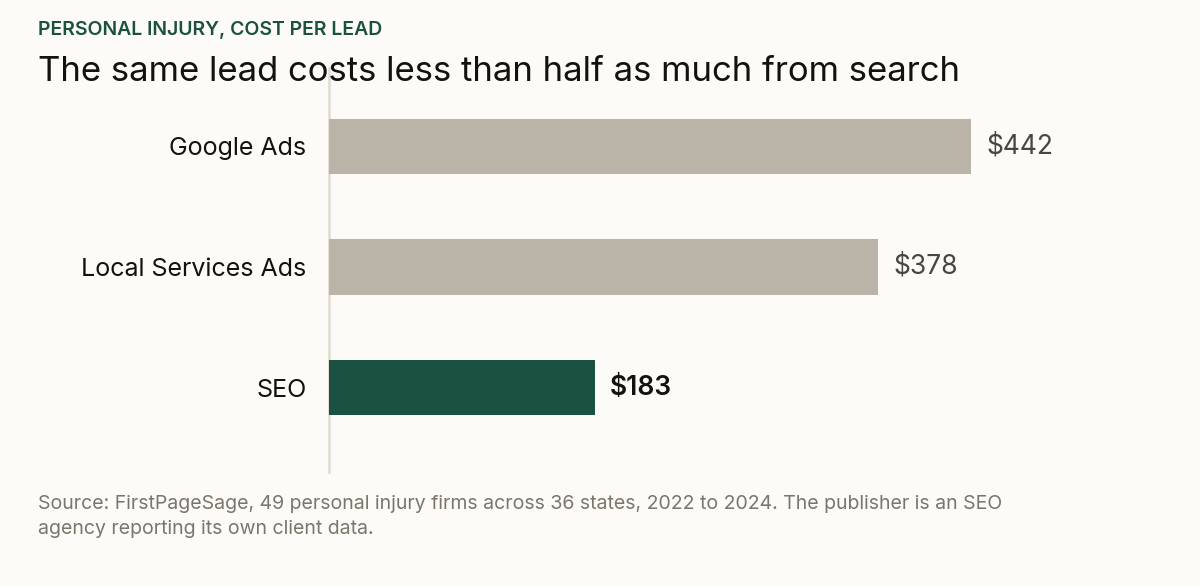
Before you use that ratio for anything, note who published it. First Page Sage is an SEO agency, the figures come from their own client base, and the finding is that SEO is the cheapest channel. I am also an SEO consultant quoting it to you. Weigh both of us accordingly. What makes me willing to use the number anyway is that the direction matches every PI account I have looked at, and the ratio survives being made a great deal less flattering, which is the next section.
That gap, roughly two and a half times, is the entire argument, and it is a better argument than anything about authority or compounding. You are not choosing between marketing and no marketing. You are choosing between paying for every click for as long as you want the phone to ring, and building something that keeps producing after you stop paying for it.
The honest version of that argument
If I only told you the two numbers I would be doing what everyone else does, so here is the part that usually gets left out.
The $183 is not free either. It is the blended cost of the work that produced it, meaning the content, the technical fixes, the profile management and the links, divided by the leads that resulted. It looks cheaper because the asset keeps working; it is not cheaper on day one.
It is much slower. Ads produce a lead the afternoon you switch them on. Search takes about six weeks to start showing and months to prove. If you need cases this quarter, the $442 lead is the correct purchase and I would tell you to make it.
The averages hide enormous variance. A firm in a top-five metro competing against firms spending five figures a month on links will not hit $183. A firm in a secondary market with a decent site and no serious local competition may beat it comfortably. An average across a market you are not in is a starting point for a conversation, not a forecast.
Neither number is a signed case. Both are leads. What happens between a lead and a retainer is your intake, your reviews and your reputation, and no amount of marketing spend touches it. I have watched firms spend a year improving visibility while losing people at the front door, and the marketing was working perfectly the whole time.
Why I would still make the case
Because the gap is wide enough to survive being wrong about it. Move both numbers against the organic side by a substantial margin and it still comes out ahead, and on the search side you own an asset that keeps producing without a daily budget.
And the two are not alternatives. Almost every PI firm I have looked at should be running both: ads carrying the near term while the organic side is built, then ads narrowing to the highest-intent terms once search is producing. The mistake is treating it as a switch rather than a sequence. To be plain about it: I think a personal injury firm should have money in Google Ads. Not instead of this, alongside it.
What actually moves the organic number
Four things, in the order I would do them.
- The primary category on your Google Business Profile. The single largest Maps ranking factor in this vertical. Wrong category and everything downstream is wasted effort, and it takes thirty seconds to check.
- Practice area pages for the case types you actually take. Not one page called “Personal Injury” with a bulleted list. Somebody who was hit by a truck is not searching “personal injury attorney”. They are searching the thing that happened to them, and those queries have a fraction of the competition of the head term and far more intent behind them.
- Service area pages, but only real ones. A firm genuinely handling cases across a metro should have a page for each area, with different courts, different accident patterns, different content. The same page with the place name swapped is a doorway, Google names it specifically as spam, and it fails as a set, dragging down the pages that would have been fine on their own.
- Review velocity, not review count. Higher counts correlate with higher local position. Higher star ratings, on their own, do not show a measurable effect. A firm with sixty reviews and a new one every fortnight will outrank a firm with two hundred from three years ago.
When the maths does not work
Two situations where I would not take this on, and it is worth saying because everyone in this market promises the top three.
A top-five metro with no budget for links. Be realistic about the ceiling. The firms above you have been spending five figures a month for years and the gap is not closed by better on-page work.
No intake capacity. If calls already go to voicemail after six, more visibility buys you more missed calls at $183 each. Fix the front door first. It costs nothing and it improves every channel you are already running.
The short version
- Competitive PI clicks: $150–$300, over $500 in LA, New York and Miami, past $1,000 for some injury types.
- Average lead cost: $442 from ads, $183 from search.
- The gap is the argument. The caveats are that search is slower, the $183 is not free, and neither number is a signed case.
- Run both. Ads for the near term, search for the asset, and narrow the ads as search starts producing.
- If your intake does not answer the phone, none of this matters yet.
If a site should be ranking and it isn’t, that’s the work I do. SEO for personal injury law firms has a twelve-month case with the profile data behind it, and SEO consulting covers how I work with firms that have a marketing team already.